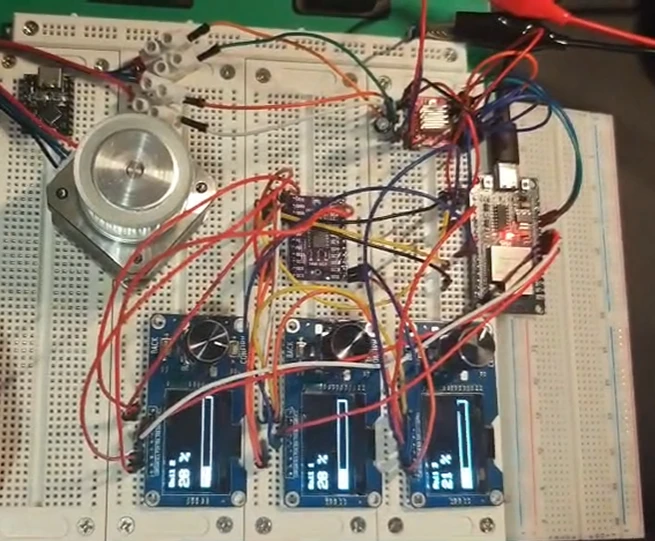
What I Built
The HSV tests graduate to motion control. The three HSV channels became three generic control channels: Rail 1, Rail 2 and Rail 3, each 0-100, each still driven by its encoder and its web slider. What changed is what hangs off the end. Rail 1 now maps to a stepper motor through an A4988 driver on a 24V supply, and the whole thing stays non-blocking: the OLEDs and the web page keep working while the motor moves.
The ESP32-to-A4988 wiring: GPIO 12 ── DIRECTION, GPIO 13 ── STEP, 3.3V ── SLEEP and RESET, GND ── MS1, MS2, MS3 and ENABLE.
Only Rail 1 is wired to a motor right now. Rail 2 and 3 stay free for future axes.
Hardware
| Component | Qty | Purpose |
|---|---|---|
| ESP32 | 1 | Main controller |
| A4988 stepper driver | 1 | Stepper motor driver |
| 24V stepper motor | 1 | Actuator |
| 24V external power supply | 1 | Motor power |
| 47µF / 50V electrolytic capacitor | 1 | VMOT power filtering |
| TCA9548A | 1 | I2C multiplexer |
| 1.3“ SH1106 OLED + EC11 module | 3 | Rail display and control |
The motor runs from its own supply. The ESP32 only provides logic signals.
Pin Assignment
| ESP32 GPIO | Function |
|---|---|
| GPIO 21 | I2C SDA |
| GPIO 22 | I2C SCL |
| GPIO 25 | Encoder 1 A |
| GPIO 18 | Encoder 1 B |
| GPIO 26 | Encoder 2 A |
| GPIO 27 | Encoder 2 B |
| GPIO 4 | Encoder 3 A |
| GPIO 16 | Encoder 3 B |
| GPIO 12 | A4988 DIRECTION |
| GPIO 13 | A4988 STEP |
The A4988 takes two new pins: 12 for direction, 13 for step. Everything else stays exactly where it was in the HSV tests.
A4988 Wiring
Logic and control pins
| A4988 Pin | Connection | Function |
|---|---|---|
| DIRECTION | ESP32 GPIO 12 | Motor direction |
| STEP | ESP32 GPIO 13 | Step pulse |
| SLEEP | 3.3V | Keep driver awake |
| RESET | 3.3V | Release reset |
| MS1 | GND | Full-step mode |
| MS2 | GND | Full-step mode |
| MS3 | GND | Full-step mode |
| ENABLE | GND | Driver continuously enabled |
Power
The A4988 has two power domains. VDD gets the ESP32’s 3.3V for the logic side. VMOT gets the external 24V supply for the motor side. The 24V negative terminal ties to the A4988’s motor-side GND, and the ESP32 GND joins the same node, so the STEP and DIRECTION signals share a reference with the driver.
The 24V supply never touches the ESP32’s 3.3V or 5V pins.
VMOT capacitor
A 47µF / 50V electrolytic sits right at the A4988’s VMOT input, positive to VMOT, negative to GND. It gives the motor supply local energy storage and smooths the voltage swings the driver’s switching creates. The 50V rating leaves comfortable headroom over the 24V rail.
Stepper motor
The motor has four wires, two coils: 1A/1B for coil A, 2A/2B for coil B. Wire colors vary by motor, so the reliable way to pair them is a multimeter: wires of the same coil show a measurable resistance, wires of different coils read open.
Microstepping
The first test runs full-step, with MS1/MS2/MS3 all tied to GND, on purpose. The relationship between STEP pulses and movement stays obvious, which is what a first test needs. Microstepping can come later when smoothness or fine positioning matters.
Rail Architecture
The HSV variables hVal, sVal and vVal became rail1Val, rail2Val and rail3Val. Each Rail spans 0-100. Encoder 1 drives Rail 1, encoder 2 drives Rail 2, encoder 3 drives Rail 3; the web sliders write the same values; each OLED shows its Rail. The three channels no longer know anything about color.
Rail 1 to Motor Mapping
Rail 1 maps linearly to a target step count:
Rail 1 = 0   → 0 steps
Rail 1 = 10  → 100 steps
Rail 1 = 50  → 500 steps
Rail 1 = 100 → 1000 steps
The 1000-step ceiling is a test value, not one motor revolution. Actual rotation depends on the motor’s step angle and the microstepping setting.
Motor Software
Two pins do the work: STEP and DIRECTION. The firmware keeps two positions:
long currentStep;
long targetStep;
targetStep is the position Rail 1 asked for, currentStep is where the software thinks the motor is. When the two differ, the controller pulses STEP until they match, with DIRECTION set by which side is ahead.
The stepping is non-blocking. The main loop cycles through the web server, encoder processing, one motor step per interval (1000µs) and OLED refresh, then repeats. The web page and the other two encoders stay responsive the whole time the motor moves. The structure is also ready for three A4988s later.
Web Interface
Same page concept as the HSV rig, now with three Rail sliders (0-100). Moving Rail 1 in the browser changes the motor target exactly like turning encoder 1. The /get endpoint exposes the current Rail values plus currentStep and targetStep, and the browser syncs against it periodically.
Test Procedure
No full-range commands on the first run. Power on and verify each stage: ESP32 boot, OLED init, TCA9548A communication, encoder input, WiFi connection, A4988 control signals. Then Rail 1 in small steps: 1, 5, 10, 20, 50. The motor followed every one of them.
Result
The test passed. The ESP32 drove the A4988 over GPIO 12/13, the A4988 drove the 24V stepper, and the existing three-channel UI kept working throughout. Rail 1 moved from both the EC11 knob and the web page, with its value showing on OLED 1. Rails 2 and 3 sit there as independent channels for future motors or other actuators.
Current Architecture
ESP32 ── TCA9548A multiplexer ── 3× OLED + EC11 modules; on the other side, ESP32 ── A4988 motor driver ── 42mm stepper motor.
Safety Notes
- Motor and logic supplies stay separate. 24V only goes to the A4988’s motor input; the ESP32 supplies the logic rail.
- Grounds are common, so STEP and DIRECTION share a reference.
- The electrolytic cap went in with correct polarity: + to VMOT, − to GND. It’s rated 50V on a 24V rail.
- Never connect or disconnect the motor while the driver is powered. The inductive load throws voltage transients that can kill the driver.
- Set the A4988 current limit to the motor’s rated current before sustained operation.
What’s Next
The single-motor test is the template for a three-axis rig:
Rail 1 → A4988 → Motor 1
Rail 2 → A4988 → Motor 2
Rail 3 → A4988 → Motor 3
Three A4988s, three motors, same software structure.
Full Code
/*
* ESP32 + TCA9548A + 3x (OLED + EC11)
* + WiFi web control
* + A4988 stepper motor
*
* Rail 1 → A4988 → Stepper Motor
* Rail 2 → independent control variable
* Rail 3 → independent control variable
*
* A4988:
* STEP GPIO 13
* DIRECTION GPIO 12
* SLEEP 3.3V
* RESET 3.3V
* MS1 GND
* MS2 GND
* MS3 GND
* ENABLE GND
*
* Motor power:
* VMOT → external 24V
* GND → 24V supply GND
*
* ESP32 GND and 24V supply GND are common
*/
#include <WiFi.h>
#include <WebServer.h>
#include <Wire.h>
#include <Adafruit_GFX.h>
#include <Adafruit_SH110X.h>
// ==================== WiFi ====================
const char* ssid = "YOUR_WIFI_SSID";
const char* password = "YOUR_WIFI_PASSWORD";
// ==================== I2C ====================
#define SDA_PIN 21
#define SCL_PIN 22
#define TCA_ADDR 0x70
// ==================== Encoders ====================
#define ENC1_A 25
#define ENC1_B 18
#define ENC2_A 26
#define ENC2_B 27
#define ENC3_A 4
#define ENC3_B 16
// ==================== A4988 ====================
#define A4988_DIR 12
#define A4988_STEP 13
// ==================== OLED ====================
Adafruit_SH1106G disp1(128, 64, &Wire, -1);
Adafruit_SH1106G disp2(128, 64, &Wire, -1);
Adafruit_SH1106G disp3(128, 64, &Wire, -1);
// ==================== Web server ====================
WebServer server(80);
// ==================== Rail state ====================
int rail1Val = 0;
int rail2Val = 0;
int rail3Val = 0;
// ==================== Encoder state machine ====================
static const int8_t KNOB_DIR[16] = {
0, -1, 1, 0,
1, 0, 0, -1,
-1, 0, 0, 1,
0, 1, -1, 0
};
volatile uint8_t encState[3] = {0, 0, 0};
volatile int8_t encDelta[3] = {0, 0, 0};
// ==================== A4988 motor control ====================
long currentStep = 0; // software position
long targetStep = 0; // position requested by Rail 1
const long MAX_MOTOR_STEPS = 1000; // Rail 1 = 100 → 1000 steps
const unsigned long STEP_INTERVAL_US = 1000; // smaller = faster
unsigned long lastStepMicros = 0;
// ==================== Web page ====================
const char htmlPage[] PROGMEM = R"rawliteral(
<!DOCTYPE html>
<html>
<head>
<meta charset="utf-8">
<meta name="viewport" content="width=device-width,initial-scale=1.0,user-scalable=yes">
<title>Rail Controller</title>
<style>
:root{--bg:#000;--text:#f5f5f7;--card-bg:rgba(28,28,30,0.65);--slider-track:#3a3a3c;--slider-thumb:#0a84ff;--border:rgba(255,255,255,0.15);--shadow:rgba(0,0,0,0.5);}
body.light{--bg:#f2f2f7;--text:#1c1c1e;--card-bg:rgba(255,255,255,0.7);--slider-track:#c7c7cc;--slider-thumb:#007aff;--border:rgba(0,0,0,0.1);--shadow:rgba(0,0,0,0.08);}
body{font-family:-apple-system,BlinkMacSystemFont,'Segoe UI',Roboto,sans-serif;background-color:var(--bg);color:var(--text);margin:0;padding:20px;display:flex;justify-content:center;align-items:center;min-height:100vh;transition:background-color .3s ease,color .3s ease;}
.container{width:100%;max-width:480px;background:var(--card-bg);backdrop-filter:blur(30px);-webkit-backdrop-filter:blur(30px);border-radius:32px;padding:30px 28px;box-shadow:0 20px 50px var(--shadow);border:1px solid var(--border);}
.header{display:flex;justify-content:space-between;align-items:center;margin-bottom:25px;}
h1{font-size:22px;font-weight:600;margin:0;letter-spacing:-.4px;}
.theme-toggle{background:rgba(255,255,255,.15);border:none;border-radius:50%;width:42px;height:42px;font-size:18px;cursor:pointer;color:var(--text);display:flex;align-items:center;justify-content:center;transition:transform .2s;}
.theme-toggle:hover{transform:scale(1.08);}
.slider-group{margin:20px 0;}
.slider-group label{display:flex;align-items:center;justify-content:space-between;font-size:15px;font-weight:500;gap:8px;}
.slider-group span{min-width:50px;text-align:right;font-weight:600;font-variant-numeric:tabular-nums;}
input[type="range"]{-webkit-appearance:none;appearance:none;width:100%;height:6px;border-radius:3px;background:var(--slider-track);outline:none;margin:12px 0;}
input[type="range"]::-webkit-slider-thumb{-webkit-appearance:none;appearance:none;width:24px;height:24px;border-radius:50%;background:var(--slider-thumb);border:2px solid rgba(255,255,255,.3);cursor:pointer;box-shadow:0 2px 10px rgba(0,0,0,.3);}
input[type="range"]::-moz-range-thumb{width:22px;height:22px;border-radius:50%;background:var(--slider-thumb);border:2px solid rgba(255,255,255,.3);cursor:pointer;}
.info{margin-top:25px;font-size:13px;opacity:.75;text-align:center;font-weight:500;line-height:1.6;}
.status-dot{display:inline-block;width:8px;height:8px;border-radius:50%;background:#30d158;margin-right:6px;vertical-align:middle;animation:pulse 2s infinite;}
@keyframes pulse{0%,100%{opacity:1;}50%{opacity:.4;}}
</style>
</head>
<body class="dark">
<div class="container">
<div class="header"><h1>Rail Control</h1><button class="theme-toggle" id="theme-toggle">☀️</button></div>
<div class="slider-group"><label>Rail 1 <span id="rail1-val">0</span></label><input id="rail1" type="range" min="0" max="100" value="0"></div>
<div class="slider-group"><label>Rail 2 <span id="rail2-val">0</span></label><input id="rail2" type="range" min="0" max="100" value="0"></div>
<div class="slider-group"><label>Rail 3 <span id="rail3-val">0</span></label><input id="rail3" type="range" min="0" max="100" value="0"></div>
<div class="info" id="info"><span class="status-dot"></span>Rail 1: 0 | Rail 2: 0 | Rail 3: 0</div>
</div>
<script>
let R1 = 0, R2 = 0, R3 = 0;
let lastInteraction = 0;
const elR1 = document.getElementById('rail1');
const elR2 = document.getElementById('rail2');
const elR3 = document.getElementById('rail3');
const elR1v = document.getElementById('rail1-val');
const elR2v = document.getElementById('rail2-val');
const elR3v = document.getElementById('rail3-val');
const info = document.getElementById('info');
function updateUI(){
if(document.activeElement !== elR1) elR1.value = R1;
if(document.activeElement !== elR2) elR2.value = R2;
if(document.activeElement !== elR3) elR3.value = R3;
elR1v.textContent = R1;
elR2v.textContent = R2;
elR3v.textContent = R3;
info.innerHTML = '<span class="status-dot"></span>' +
'Rail 1: ' + R1 + ' | ' +
'Rail 2: ' + R2 + ' | ' +
'Rail 3: ' + R3;
}
function sendRails(){
lastInteraction = Date.now();
fetch('/rail?value=' + Math.round(R1) + ',' + Math.round(R2) + ',' + Math.round(R3)).catch(()=>{});
}
elR1.addEventListener('input', function(){ R1 = Number(this.value); updateUI(); sendRails(); });
elR2.addEventListener('input', function(){ R2 = Number(this.value); updateUI(); sendRails(); });
elR3.addEventListener('input', function(){ R3 = Number(this.value); updateUI(); sendRails(); });
setInterval(function(){
if(Date.now() - lastInteraction < 800) return;
fetch('/get').then(r => r.json()).then(d => {
if(d.r1 !== R1 || d.r2 !== R2 || d.r3 !== R3){
R1 = d.r1; R2 = d.r2; R3 = d.r3;
updateUI();
}
}).catch(()=>{});
}, 400);
const themeToggle = document.getElementById('theme-toggle');
const body = document.body;
const savedTheme = localStorage.getItem('theme');
if(savedTheme === 'light'){
body.classList.remove('dark');
body.classList.add('light');
themeToggle.innerHTML = '🌙';
}
themeToggle.addEventListener('click', function(){
if(body.classList.contains('dark')){
body.classList.remove('dark');
body.classList.add('light');
themeToggle.innerHTML = '🌙';
localStorage.setItem('theme', 'light');
} else {
body.classList.remove('light');
body.classList.add('dark');
themeToggle.innerHTML = '☀️';
localStorage.setItem('theme', 'dark');
}
});
updateUI();
</script>
</body>
</html>
)rawliteral";
// ==================== TCA9548A ====================
bool tcaSelect(uint8_t ch) {
for (int i = 0; i < 3; i++) {
Wire.beginTransmission(TCA_ADDR);
Wire.write(1 << ch);
if (Wire.endTransmission() == 0) return true;
delayMicroseconds(100);
}
return false;
}
// ==================== OLED draw ====================
void drawOne(Adafruit_SH1106G &disp, const char* label, int value) {
disp.clearDisplay();
disp.setTextSize(1);
disp.setTextColor(SH110X_WHITE);
disp.setCursor(0, 0);
disp.print(label);
disp.setTextSize(2);
disp.setCursor(0, 14);
disp.print(value);
disp.print(" %");
disp.drawRect(0, 46, 128, 14, SH110X_WHITE); // frame
int fillW = map(value, 0, 100, 0, 126); // progress bar
if (fillW > 0) disp.fillRect(1, 47, fillW, 12, SH110X_WHITE);
disp.display();
}
// ==================== Refresh all three OLEDs ====================
void refreshAll() {
if (tcaSelect(0)) drawOne(disp1, "Rail 1", rail1Val);
if (tcaSelect(1)) drawOne(disp2, "Rail 2", rail2Val);
if (tcaSelect(2)) drawOne(disp3, "Rail 3", rail3Val);
}
// ==================== Encoder ISRs ====================
void IRAM_ATTR isrEnc1() {
uint8_t s = (digitalRead(ENC1_A) << 1) | digitalRead(ENC1_B);
encState[0] = ((encState[0] << 2) | s) & 0x0F;
int8_t d = KNOB_DIR[encState[0]];
if (d) encDelta[0] += d;
}
void IRAM_ATTR isrEnc2() {
uint8_t s = (digitalRead(ENC2_A) << 1) | digitalRead(ENC2_B);
encState[1] = ((encState[1] << 2) | s) & 0x0F;
int8_t d = KNOB_DIR[encState[1]];
if (d) encDelta[1] += d;
}
void IRAM_ATTR isrEnc3() {
uint8_t s = (digitalRead(ENC3_A) << 1) | digitalRead(ENC3_B);
encState[2] = ((encState[2] << 2) | s) & 0x0F;
int8_t d = KNOB_DIR[encState[2]];
if (d) encDelta[2] += d;
}
// ==================== Update A4988 target ====================
void updateMotorTarget() {
targetStep = map(rail1Val, 0, 100, 0, MAX_MOTOR_STEPS);
}
// ==================== Non-blocking stepper control ====================
void updateMotor() {
if (currentStep == targetStep) return;
unsigned long now = micros();
if (now - lastStepMicros < STEP_INTERVAL_US) return;
lastStepMicros = now;
// direction
if (targetStep > currentStep) digitalWrite(A4988_DIR, HIGH);
else digitalWrite(A4988_DIR, LOW);
// STEP pulse
digitalWrite(A4988_STEP, HIGH);
delayMicroseconds(3);
digitalWrite(A4988_STEP, LOW);
// update software position
if (targetStep > currentStep) currentStep++;
else currentStep--;
}
// ==================== Handle encoders ====================
void handleEncoders() {
int8_t d[3];
noInterrupts();
d[0] = encDelta[0]; encDelta[0] = 0;
d[1] = encDelta[1]; encDelta[1] = 0;
d[2] = encDelta[2]; encDelta[2] = 0;
interrupts();
bool changed = false;
// -------------------- Rail 1 --------------------
if (d[0] != 0) {
rail1Val = constrain(rail1Val + d[0], 0, 100);
updateMotorTarget();
changed = true;
}
// -------------------- Rail 2 --------------------
if (d[1] != 0) {
rail2Val = constrain(rail2Val + d[1], 0, 100);
changed = true;
}
// -------------------- Rail 3 --------------------
if (d[2] != 0) {
rail3Val = constrain(rail3Val + d[2], 0, 100);
changed = true;
}
if (changed) refreshAll();
}
// ==================== HTTP root ====================
void handleRoot() {
server.send_P(200, "text/html; charset=utf-8", htmlPage);
}
// ==================== HTTP rail ====================
void handleRail() {
if (server.hasArg("value")) {
String val = server.arg("value");
int p1 = val.indexOf(',');
int p2 = val.indexOf(',', p1 + 1);
if (p1 > 0 && p2 > p1) {
rail1Val = constrain(val.substring(0, p1).toInt(), 0, 100);
rail2Val = constrain(val.substring(p1 + 1, p2).toInt(), 0, 100);
rail3Val = constrain(val.substring(p2 + 1).toInt(), 0, 100);
updateMotorTarget();
refreshAll();
}
}
server.send(200, "text/plain", "OK");
}
// ==================== HTTP get ====================
void handleGet() {
char buf[100];
snprintf(buf, sizeof(buf),
"{\"r1\":%d,\"r2\":%d,\"r3\":%d,\"currentStep\":%ld,\"targetStep\":%ld}",
rail1Val, rail2Val, rail3Val, currentStep, targetStep);
server.send(200, "application/json", buf);
}
// ==================== Setup ====================
void setup() {
Serial.begin(115200);
delay(500);
Serial.println("\n=== ESP32 Rail Controller ===");
// --- A4988 GPIO ---
pinMode(A4988_DIR, OUTPUT);
pinMode(A4988_STEP, OUTPUT);
digitalWrite(A4988_DIR, LOW);
digitalWrite(A4988_STEP, LOW);
Serial.println("A4988 GPIO initialized.");
// --- I2C ---
Wire.begin(SDA_PIN, SCL_PIN);
Wire.setClock(100000);
delay(100);
// --- OLED self-test ---
Adafruit_SH1106G* disps[3] = { &disp1, &disp2, &disp3 };
for (int ch = 0; ch < 3; ch++) {
if (!tcaSelect(ch)) {
Serial.printf("!! tcaSelect(%d) FAIL\n", ch);
continue;
}
delay(20);
if (!disps[ch]->begin(0x3C, true)) {
Serial.printf("!! OLED %d begin FAIL\n", ch + 1);
} else {
Serial.printf("OK OLED %d\n", ch + 1);
// self-test: big number
disps[ch]->clearDisplay();
disps[ch]->setTextSize(5);
disps[ch]->setTextColor(SH110X_WHITE);
char num[2] = { (char)('1' + ch), 0 };
disps[ch]->setCursor(50, 12);
disps[ch]->print(num);
disps[ch]->display();
}
}
delay(800);
// --- Encoders ---
const uint8_t aPin[3] = {ENC1_A, ENC2_A, ENC3_A};
const uint8_t bPin[3] = {ENC1_B, ENC2_B, ENC3_B};
for (int i = 0; i < 3; i++) {
pinMode(aPin[i], INPUT_PULLUP);
pinMode(bPin[i], INPUT_PULLUP);
encState[i] = (digitalRead(aPin[i]) << 1) | digitalRead(bPin[i]);
}
attachInterrupt(digitalPinToInterrupt(ENC1_A), isrEnc1, CHANGE);
attachInterrupt(digitalPinToInterrupt(ENC1_B), isrEnc1, CHANGE);
attachInterrupt(digitalPinToInterrupt(ENC2_A), isrEnc2, CHANGE);
attachInterrupt(digitalPinToInterrupt(ENC2_B), isrEnc2, CHANGE);
attachInterrupt(digitalPinToInterrupt(ENC3_A), isrEnc3, CHANGE);
attachInterrupt(digitalPinToInterrupt(ENC3_B), isrEnc3, CHANGE);
// --- First frame ---
refreshAll();
// --- WiFi ---
WiFi.mode(WIFI_STA);
WiFi.setSleep(false); // keep WiFi from interfering with I2C
WiFi.setTxPower(WIFI_POWER_11dBm); // keep the TX spike from resetting the board
Serial.printf("Connecting to %s ", ssid);
WiFi.begin(ssid, password);
uint32_t t0 = millis();
while (WiFi.status() != WL_CONNECTED && millis() - t0 < 20000) {
delay(500);
Serial.print(".");
}
Serial.println();
if (WiFi.status() == WL_CONNECTED) {
Serial.print("WiFi OK. IP: ");
Serial.println(WiFi.localIP());
} else {
Serial.println("WiFi failed");
}
delay(300);
refreshAll(); // refresh once more after WiFi settles
// --- HTTP routes ---
server.on("/", handleRoot);
server.on("/rail", handleRail);
server.on("/get", handleGet);
server.begin();
Serial.println("HTTP server on port 80");
Serial.println("Ready.");
Serial.println();
Serial.println("Rail 1 controls A4988.");
Serial.println("Rail 1 = 0 -> 0 step");
Serial.println("Rail 1 = 100 -> 1000 step");
}
// ==================== Loop ====================
uint32_t lastRefresh = 0;
void loop() {
server.handleClient(); // WiFi
handleEncoders(); // three knobs
updateMotor(); // A4988
// refresh OLEDs every 3 seconds (against display drift)
if (millis() - lastRefresh > 3000) {
lastRefresh = millis();
refreshAll();
}
delay(1);
}