The Assignment
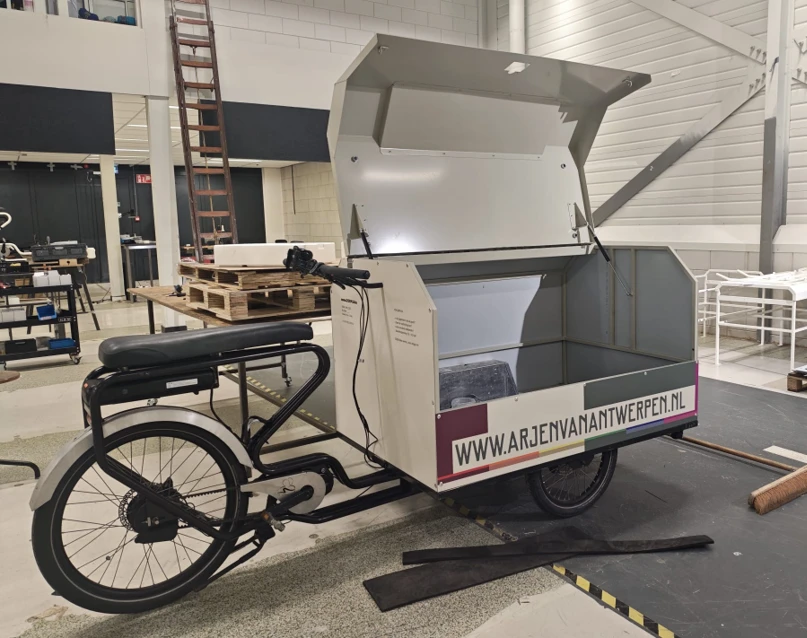
ZOEM Bike is a Dutch cargo bike builder. Our assignment came from one of their clients: a single painter, who ordered a personally customized cargo box for his ZOEM chassis. The box carries ladders, paint buckets and tools through city traffic every working day. I worked in a two-person project group together with another industrial design intern; I was mainly responsible for material analysis and selection, physics calculations and testing, gas spring testing, ergonomic calculations, 3D rendering, Photoshop processing of the stickers, and the final assembly of the finished product.
The project ran through the full development cycle. We researched existing market solutions, compared the feasibility of different components, and analyzed the client’s pain points in the field. Those findings were then turned into an optimized design, produced, installed and delivered to the client at the end of the project.
Design Goals
The starting point was the current cargo box. Functional, but carrying years of accumulated compromises. The redesign brief came down to five targeted changes:
| Change | Design Rationale |
|---|---|
| One side cover instead of two | One lid is more convenient to open than two, and it only needs one lock instead of two different keys. The new box opens from one side only, facing right: when the bike is parked along a street, the painter opens the box on the pavement side instead of into car traffic, safer for loading and unloading. |
| Redesigned waterproofing system | Merging two lids into one meant the sealing and the entire frame structure had to be redesigned around the new opening. |
| Redesigned structural frame | The opening lid works together with the hinge and stays under continuous pressure from the gas spring when closed. The lid was reinforced against deformation, and the sheet metal shell was protected from damage during opening, closing and static closed-state load. |
| Redesigned hinge mechanism | Stainless steel, built for repeated open/close cycles, waterproof and rust-resistant. It is riveted in place and sits as straight as the fixed U-profile steel it mounts to. |
| Lighter materials | Strong where it needs to be strong, light everywhere else: a steel profile frame carries the loads, while an Alupanel aluminium composite shell keeps the whole bike light (the same logic as a car’s A-pillar versus its body panels), freeing capacity for more cargo. |

The client's previous standard box
The Finished Product

Box detail: top

Redesigned box

Box detail: bottom
Research & Analysis
Before any CAD work started, the redesign was built on three inputs: research into existing market solutions, a comparison of component options for feasibility and cost, and direct interviews with the painter (the client who will use this box) every day.
Research Questions
Every design decision had to answer one of these five questions, written down before the first sketch:
- How do we choose a gas spring: easy to open, gentle when closed?
- How can daily use be made more user-friendly?
- How can the box offer enough functionality?
- How can it be waterproof from every angle?
- How can the box be made more attractive?
Design Details
The client answered our questions directly. The answers below steered several design choices:
- Lid weight: around 10–12 kg, measured in SolidWorks. The gas spring spec starts here.
- Opening range: the user wants the lid to open as far as possible.
- Material stock: 6XXX-series aluminium sheet metal for the lid: combines strength with weldability and takes anodizing well; steel for the frame.
- Frame construction: square steel tube, welded into shape.
- Leak history: the previous design let water in around the hinge; the old solution was over-engineered.
- Lid slope: allowed, not required. Without a slope, rainwater drains off naturally.
- Corrosion: aluminium parts need protection (anodized or galvanized); powder coating is also an option.
- Rivets: the current pop rivets may not be waterproof enough; closed-end blind rivets look better.
- Extra: hide the battery-to-headlight wiring.
User Profile
- The painter is 1.95 m tall, so reach height drives the ergonomics.
- Comparable lids on this design use relatively thin aluminium sheet.
- Gas springs are worth considering for the lid, since it also carries a 15 kg ladder on top.
- The box stands about 75 cm high.
- The handlebar must sit at the same height as a standard ZOEM handlebar.
- A cargo bike cabin itself carries a fair amount of weight.
Material Analysis
Initial Sketches

Material Research & Selection
Corrosion
When aluminium makes contact with stainless steel fasteners, corrosion can occur. This is known as galvanic corrosion. It happens when two materials, an anode and a cathode, come into contact with each other through an electrolyte (rainwater is enough).
Final choice: powder coating for both the steel frame and the aluminium parts. Process: sheet metal processed and welded at the factory (our workshop cannot weld aluminium) → shipped back for assembly and testing → holes drilled (after this point no further changes were possible) → sent to another factory for powder coating → shipped back for final assembly. Corrosion is designed to stay within the product's expected service life.
Source: 1. Why Can't You Use Stainless Steel and Aluminum Together?
Hinge types
Pivot hinge: 10–15 years service life; hidden design; load capacity; aesthetic.
Piano hinge: 60 years service life; evenly distributed weight; load capacity; sturdiness.
Butt / heavy-duty hinge: 5–7 years service life; cheap; load capacity.
Final choice: stainless steel piano hinge: long service life with load distributed evenly along the full length, matching the stainless, waterproof and rust-resistant requirement of the brief. Sponsored by Lino Metaalwaren.
Source: 1. Camax Hardware 2. China industrial hinges factory
Rivet choice
POP closed-end blind rivets offer up to 23% greater tensile strength than POP open-end rivets, as well as zero penetration by liquids or gas at pressure. Closed-end rivets are available in a variety of rivet/mandrel material combinations.
Waterproofing was checked against the IPX rating scale: IPX2 (dripping water), IPX4 (splashing water), IPX6 (powerful water jets, 15 psi for 3 minutes, 100 litres per minute), IPX6K (increased pressure), IPX7 (immersion).
Final choice: closed-end blind rivets: higher tensile strength and fully sealed against liquids and gas, verified against the IPX scale.
Source: 1. The Difference Between Open and Closed End Blind Rivets 2. IPX Waterproof Rating Chart (Storyteller Tech)
Gas springs
Suppliers compared: Amatec Technische Veren (standard gas springs with fixed eyes), Tevema, Gasveerwinkel (full range online, incl. configurator), and Spring Masters (from stock). A ball hinge (kogelscharnier) was also considered as an alternative mounting option.
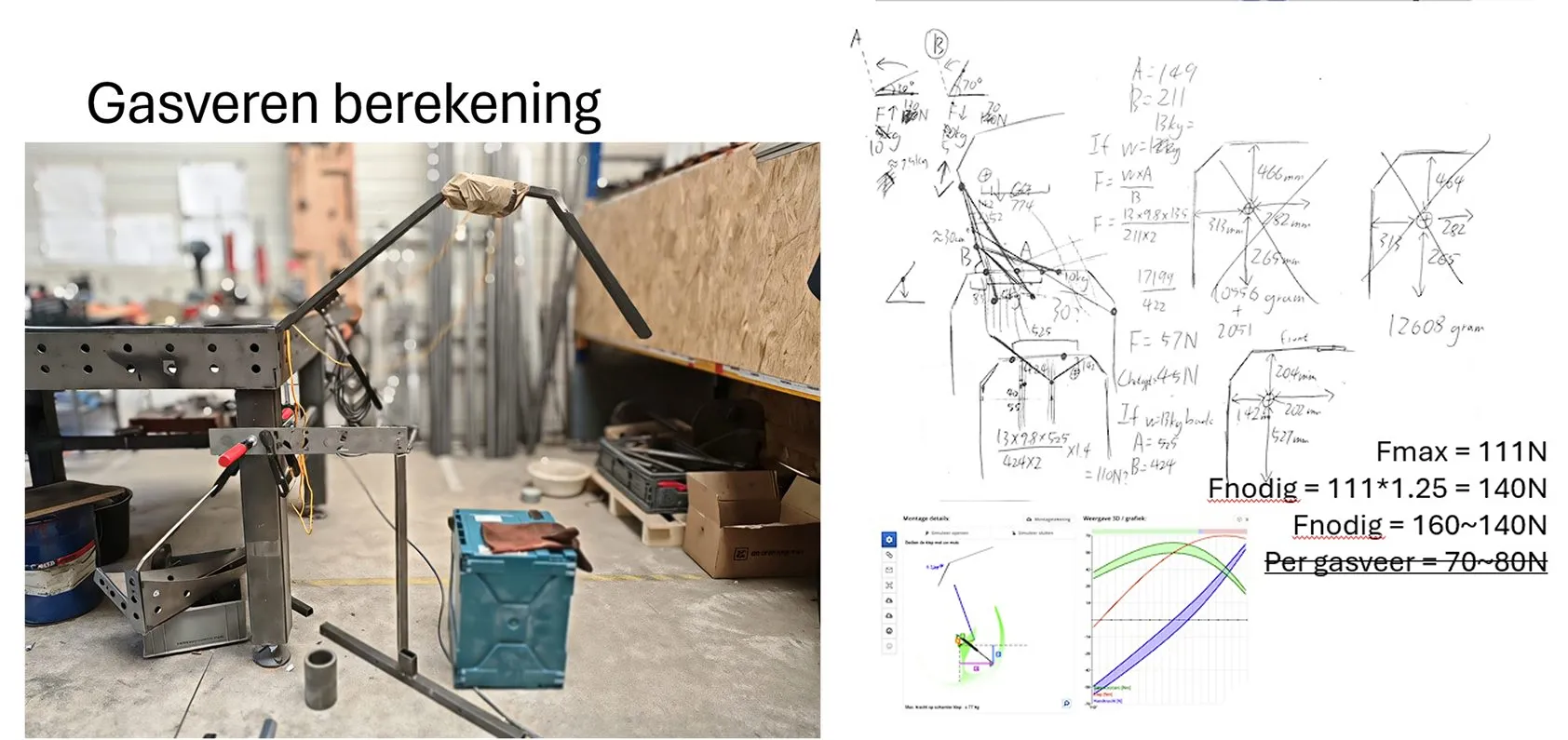
Final choice: two 250 N gas springs, holding the 10–12 kg lid through its full travel; re-selected and verified on the final assembly (during the build).
Source: 1. Gasveerwinkel 2. Gasveerexpert 3. Amatec 4. Tevema 5. Spring Masters
Fastening
Well nut: vibration-resistant, waterproof, corrosion-resistant; limited load capacity, sensitive to wear and loosening, not suitable for heavy work.
Closed-end blind rivet: vibration-resistant, waterproof, corrosion-resistant, load capacity; not serviceable, corrosion risk between metals and moisture, weaker than welding.
Sealing screw: vibration-resistant, waterproof, corrosion-resistant, load capacity, serviceable; expensive, O-ring service life.
Final choice: the square-tube steel frame was welded into shape, the hinge was fixed with rivets as specified in the brief, and the Alupanel shell was riveted to the steel frame. The rivets were tested and confirmed waterproof.
Source: 1. Well Nuts vs Nutserts 2. What Are Sealing Screws? (ACCU)
Sealing & Waterproofing
Watertightness is built from three layers: waterproof rivets, silicone sealant (glass adhesive) along the seams, and the frame geometry itself: the lid edge is shaped like a roof gutter, so rainwater runs along it and off the sides instead of flowing into the box.
Procurement
Purchased parts: piano hinge; closed-end blind rivets; gas springs; long-pole waterproof lock.
Technical Verification
Early in development we tested feasibility of the riskiest parts of the design, before committing to production:
- Gas spring selection: the lid weighs roughly 10–12 kg. We tested springs that would hold it open comfortably while minimizing mechanical fatigue in the closed state (the position where the spring spends most of its life under load.
- Field visit to Lino Metaalwaren: a local visit to a hardware specialist to understand hinge design options hands-on before specifying our own.
Design Iterations: Four Versions
The box went through four major versions before the design froze. Each round addressed the problems found in the previous one, left to right, version by version:

Version 1
Frame & Sheet Metal
Steel frame profiles adjusted to a thinner size.
Correct steel profile added to the weldment library.
Sheet metal weld point reduced in size.
Side rain gutter no longer needed, removed.
Gap between the lid side and the box enlarged.
Gas spring tested for the first time.

Version 2
First Test Build
First prototype assembled and physically tested.
Gap between the lid side and the box further enlarged.
Front side redesigned to match the back (see image).
Reinforcement added inside the housing.

Version 3
Hinge & Sizing
Switched to a different size of piano hinge.
Hinge moved to a different mounting location.
Seal repositioned for better waterproofing.
Overall weight reduced.

Version 4
U-Channel & Mounting
U-channel profile introduced for the hinge mount.
Gas spring tested for the second time.
New mounting position, so the lid was made wider to match.
Larger tolerance distance between lid and box while closing.
Waterproofing further improved.
Gas Spring Evaluation
The spring was specified from measurements and verified with a calculation sheet. The final assembly uses two 250 N gas springs to hold the lid through its full travel:
Ergonomics
The spring and the hinge only work if the human does too. Opening height, reach distance and load access were dimensioned against the painter’s working posture:

From Sketch to Delivery
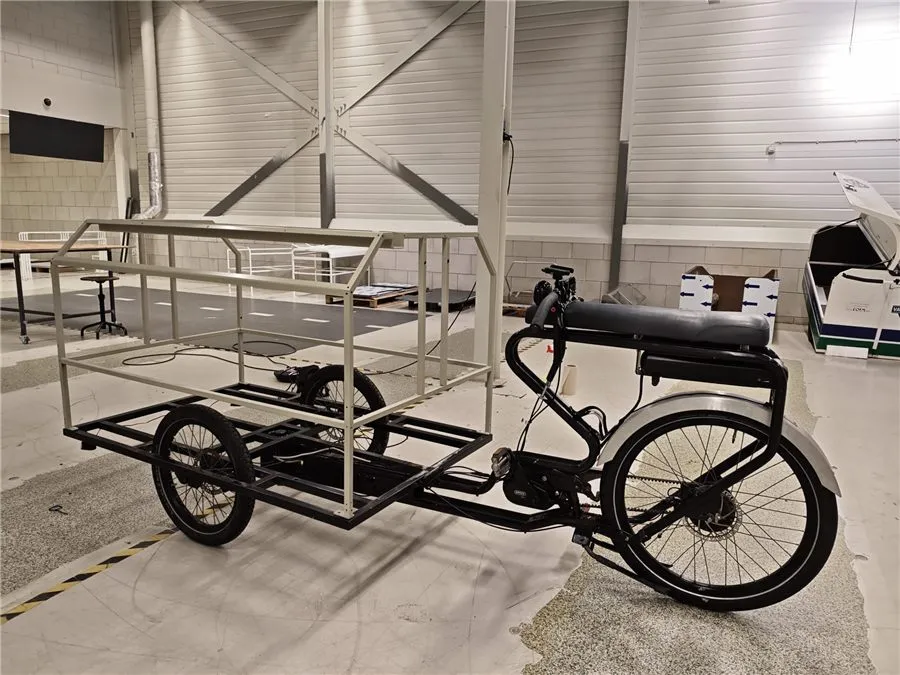
Together with my teammate I welded the frame, cut the shell panels, dismantled the old box and assembled the new one, testing the gas spring at multiple stages along the way. The gas springs were re-selected for the final assembly: two 250 N units to hold the lid through its full travel, with a healthy safety margin.
From model to metal: the final render and the real thing on the road:

Final assembly: 3D render

The real thing: test run
What I Walked Away With
This was the first project where the end of the process was a customer riding the result, not a grade, not a prototype in a drawer.
- Sheet metal is a different design language: bend radii, weld seams and powder coat tolerances all constrain the geometry long before aesthetics enter the conversation. Designing in SolidWorks and building in steel are two very different conversations.
- Design is a language of balance: every part decision (a hinge, a gas spring, a sheet thickness) weighs cost against service life, workability, lead time and the user’s daily experience. The best component on paper is rarely the best component in the product.
- Two-person teams need shared reality: with only two of us, every sketch and every decision had to be legible to the other person immediately. Documentation stopped being a chore and became the only way we stayed synchronized.
- Finishing means testing the finished thing: the final gas springs (two 250 N units) were re-selected after the lid was real. Specifications survive contact with reality only if you re-verify them at the end.
- The gas spring force was the real technical puzzle: the lid weighs about a dozen kilos on its own, but roughly thirty with the ladder on top. Both situations happen every day, and the gap between them is huge, so choosing one spring force was a genuinely complex decision.
- Ideal values are only a starting point: calculating the theoretical Newton force and predicted dimensions of a gas spring is useful, but actually installing one, opening the lid and feeling how it behaves taught me more than any ideal number in a spreadsheet.
Special thanks to Lino Metaalwaren for sponsoring the stainless steel piano hinge for this project.