What I Built
This is the first stepping stone toward a full motor control rig. Before bolting steppers and drivers onto the bench, I wanted to prove the ESP32 could juggle a few things at once without tripping over itself. So I set out to build a test platform that handles:
- Dual EC11 rotary encoder input — both encoders read simultaneously, with direction detection, incremental counting, and push button debouncing. No missed steps.
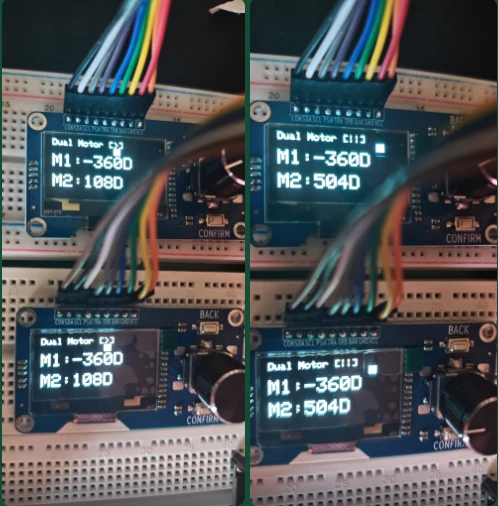
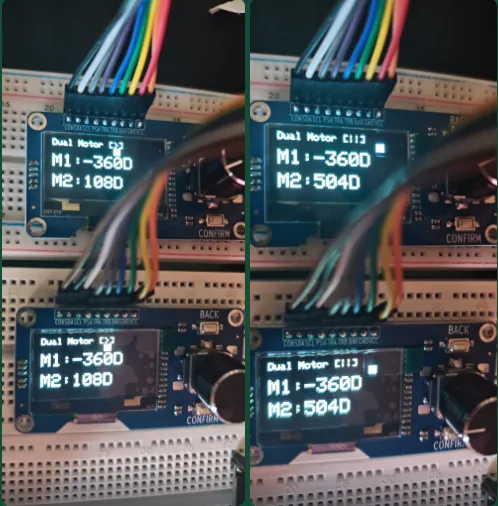
- SH1106 OLED display — both OLEDs share the same I2C bus (0x3C), refreshing angle data at 10 Hz without flicker or bus contention.
- WiFi WebSocket server — a browser-based dashboard that shows both angles in real time. WebSocket beats polling for this kind of low-latency UI, and I added heartbeat packets so the connection doesn’t time out.
- FreeRTOS multi-task architecture — three tasks pinned to Core 1: Encoder Task at 1000 Hz, Motor Task at 100 Hz, and OLED Task at 10 Hz. Core 0 handles the web server. Mutex on the motor struct keeps shared state consistent.
The goal wasn’t to build anything flashy — it was to validate that the software architecture holds up under concurrent load before I add real motors to the mix.
System Architecture
                 ESP32
            ┌───────────────┐
 Core 0     │ WebServer     │
            │ WebSocket     │
            └───────────────┘
            ┌───────────────┐
 Core 1     │ Encoder Task  │ 1000 Hz
            │ Motor Task    │  100 Hz
            │ OLED Task     │   10 Hz
            └───────────────┘
Pinout
Module 1 — Encoder + OLED
| Signal | ESP32 Pin | Function |
|---|---|---|
| SDA | GPIO21 | I2C Data |
| SCL | GPIO22 | I2C Clock |
| VCC | 3.3V | Power |
| GND | GND | Ground |
| TRA | GPIO32 | Encoder A (rotation) |
| TRB | GPIO33 | Encoder B (rotation) |
| PSH | GPIO25 | Push button |
| BAK | GPIO26 | Back button |
| CON | GPIO27 | Confirm button |
Module 2 — Encoder + OLED
| Signal | ESP32 Pin | Function |
|---|---|---|
| SDA | GPIO21 | I2C Data (shared bus) |
| SCL | GPIO22 | I2C Clock (shared bus) |
| VCC | 3.3V | Power |
| GND | GND | Ground |
| TRA | GPIO16 | Encoder A (rotation) |
| TRB | GPIO17 | Encoder B (rotation) |
| PSH | GPIO18 | Push button |
| BAK | GPIO19 | Back button |
| CON | GPIO23 | Confirm button |
Both OLED modules share the same I2C bus (GPIO21/22). Each module’s buttons and encoder use independent GPIO pins.
Web Interface
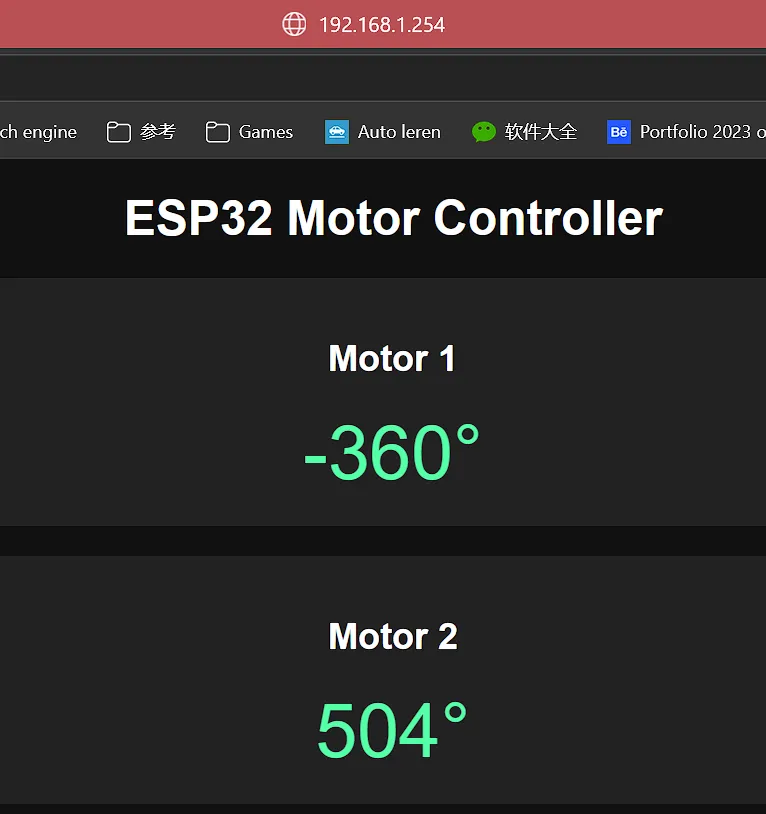
The browser connects over WebSocket and displays both encoder angles with zero perceptible lag. The JavaScript reconnect logic handles WiFi glitches gracefully — if the ESP32 drops off the network, the page quietly retries every 2 seconds until it’s back.
One small optimization I’m happy with: the Motor Task only sends data when the angle actually changed, and it throttles to a minimum 50ms interval. Without that, every encoder tick would fire a WebSocket frame and you’d flood the browser on fast spins.
OLED Display
The OLED shows:
- Current mode indicator (a little animated
[>]or[||]depending on state) - A scrolling animation bar that bounces across the top — pointless but satisfying
- Motor 1 and Motor 2 angles in degrees
Full Code
#include <WiFi.h>
#include <Wire.h>
#include <Adafruit_GFX.h>
#include <Adafruit_SH110X.h>
#include <ESP32Encoder.h>
#include <AsyncTCP.h>
#include <ESPAsyncWebServer.h>

//==============================
// WiFi
//==============================
const char* ssid = "YOUR_WIFI_USERNAME_HERE";
const char* password = "YOUR_WIFI_PASSWORD_HERE";

//==============================
// WebSocket & AsyncWebServer
//==============================
AsyncWebServer server(80);
AsyncWebSocket ws("/ws");

//==============================
// OLED
//==============================
Adafruit_SH1106G display(128, 64, &Wire);

//==============================
// Encoders
//==============================
ESP32Encoder encoder1;
ESP32Encoder encoder2;

//==============================
// Pins
//==============================
#define ENC1_A 32
#define ENC1_B 33
#define PSH1   25
#define BAK1   26
#define CON1   27

#define ENC2_A 16
#define ENC2_B 17
#define PSH2   18
#define BAK2   19
#define CON2   23

//==============================
// Motor & Animation
//==============================
struct Motor {
  long count;               // protected by mutex
  float targetAngle;
  float currentAngle;
};
Motor motor1, motor2;

volatile bool animationRunning = true;
int animationFrame = 0;

struct Button {
  int pin;
  bool lastState;
  bool pressed;
};
Button btnPSH1, btnBAK1, btnCON1;
Button btnPSH2, btnBAK2, btnCON2;

//==============================
// Synchronization
//==============================
SemaphoreHandle_t motorMutex;

// WebSocket send cache
String lastSentJson = "";
unsigned long lastHeartbeat = 0;

//==============================
// HTML (with auto-reconnect & heartbeat)
//==============================
const char webpage[] PROGMEM = R"rawliteral(
<!DOCTYPE html>
<html>
<head>
<meta charset="UTF-8">
<meta name="viewport" content="width=device-width,initial-scale=1">
<style>
body{background:#111;color:white;font-family:Arial;text-align:center;}
.card{background:#222;border-radius:20px;padding:20px;margin:20px;}
.value{font-size:50px;color:#00ffaa;}
</style>
</head>
<body>
<h1>ESP32 Motor Controller</h1>
<div class="card"><h2>Motor 1</h2><div id="m1" class="value">0°</div></div>
<div class="card"><h2>Motor 2</h2><div id="m2" class="value">0°</div></div>
<script>
function connectWS() {
  var socket = new WebSocket('ws://' + location.host + '/ws');
  socket.onmessage = function(event) {
    var data = JSON.parse(event.data);
    if (data.type === 'heartbeat') return; // ignore heartbeat packets
    document.getElementById("m1").innerHTML = data.m1 + "°";
    document.getElementById("m2").innerHTML = data.m2 + "°";
  };
  socket.onclose = function() {
    console.log('WebSocket closed, reconnecting in 2s');
    setTimeout(connectWS, 2000);
  };
  socket.onerror = function(err) {
    console.log('WebSocket error', err);
    socket.close();
  };
}
connectWS();
</script>
</body>
</html>
)rawliteral";

//==============================
// Button helpers
//==============================
void initButton(Button &btn, int pin) {
  btn.pin = pin;
  btn.lastState = HIGH;
  btn.pressed = false;
  pinMode(pin, INPUT_PULLUP);
}

void scanButton(Button &btn) {
  bool cur = digitalRead(btn.pin);
  btn.pressed = (cur == LOW && btn.lastState == HIGH);
  btn.lastState = cur;
}

//==============================
// WebSocket event
//==============================
void onWsEvent(AsyncWebSocket *server, AsyncWebSocketClient *client,
               AwsEventType type, void *arg, uint8_t *data, size_t len) {
  if (type == WS_EVT_CONNECT) {
    Serial.println("WS client connected");
    // send current angles
    xSemaphoreTake(motorMutex, portMAX_DELAY);
    float a1 = motor1.currentAngle;
    float a2 = motor2.currentAngle;
    xSemaphoreGive(motorMutex);
    char buf[64];
    snprintf(buf, sizeof(buf), "{\"m1\":%.0f,\"m2\":%.0f}", a1, a2);
    client->text(buf);
  }
}

// Broadcast message (called when data changes)
void broadcastData(float m1, float m2) {
  char buf[64];
  snprintf(buf, sizeof(buf), "{\"m1\":%.0f,\"m2\":%.0f}", m1, m2);
  // use strcmp to compare string content
  if (strcmp(buf, lastSentJson.c_str()) != 0) {
    lastSentJson = buf;          // update cache
    ws.textAll(buf);
  }
}

// Send heartbeat (keep connection alive)
void sendHeartbeat() {
  ws.textAll("{\"type\":\"heartbeat\"}");
}

//==============================
// Encoder Task (1000 Hz)
//==============================
void encoderTask(void *pv) {
  ESP32Encoder::useInternalWeakPullResistors = puType::up;
  encoder1.attachHalfQuad(ENC1_A, ENC1_B);
  encoder2.attachHalfQuad(ENC2_A, ENC2_B);
  encoder1.clearCount();
  encoder2.clearCount();

  initButton(btnPSH1, PSH1); initButton(btnBAK1, BAK1); initButton(btnCON1, CON1);
  initButton(btnPSH2, PSH2); initButton(btnBAK2, BAK2); initButton(btnCON2, CON2);

  while (true) {
    long c1 = encoder1.getCount();
    long c2 = encoder2.getCount();

    xSemaphoreTake(motorMutex, portMAX_DELAY);
    motor1.count = c1;
    motor2.count = c2;
    motor1.targetAngle = c1 * 18;
    motor2.targetAngle = c2 * 18;
    xSemaphoreGive(motorMutex);

    // button controls animation
    scanButton(btnPSH1); if(btnPSH1.pressed) animationRunning = !animationRunning;
    scanButton(btnBAK1); if(btnBAK1.pressed) animationRunning = false;
    scanButton(btnCON1); if(btnCON1.pressed) animationRunning = true;
    scanButton(btnPSH2); if(btnPSH2.pressed) animationRunning = !animationRunning;
    scanButton(btnBAK2); if(btnBAK2.pressed) animationRunning = false;
    scanButton(btnCON2); if(btnCON2.pressed) animationRunning = true;

    vTaskDelay(pdMS_TO_TICKS(5));
  }
}

//==============================
// Motor Task (500 Hz) + push + heartbeat
//==============================
void motorTask(void *pv) {
  float lastM1 = 0, lastM2 = 0;
  unsigned long lastSend = 0;                 // last push time
  const unsigned long sendInterval = 50;      // min push interval 50ms (20Hz)

  while (true) {
    xSemaphoreTake(motorMutex, portMAX_DELAY);

    // get current and target values
    float cur1 = motor1.currentAngle;
    float cur2 = motor2.currentAngle;
    float tar1 = motor1.targetAngle;
    float tar2 = motor2.targetAngle;

    // smooth angle following
    if (cur1 < tar1) cur1 += 1.0f;
    else if (cur1 > tar1) cur1 -= 1.0f;

    if (cur2 < tar2) cur2 += 1.0f;
    else if (cur2 > tar2) cur2 -= 1.0f;

    motor1.currentAngle = cur1;
    motor2.currentAngle = cur2;

    xSemaphoreGive(motorMutex);

    // send only when value changed AND interval elapsed
    if ((cur1 != lastM1 || cur2 != lastM2) &&
        (millis() - lastSend >= sendInterval)) {
      broadcastData(cur1, cur2);
      lastSend = millis();
      lastM1 = cur1;
      lastM2 = cur2;
    }

    // heartbeat every 5 seconds
    if (millis() - lastHeartbeat > 5000) {
      sendHeartbeat();
      lastHeartbeat = millis();
    }

    vTaskDelay(pdMS_TO_TICKS(10));   // 100Hz
  }
}

//==============================
// OLED Task (10 Hz)
//==============================
void oledTask(void *pv) {
  while (true) {
    float a1, a2;
    xSemaphoreTake(motorMutex, portMAX_DELAY);
    a1 = motor1.currentAngle;
    a2 = motor2.currentAngle;
    xSemaphoreGive(motorMutex);

    display.clearDisplay();
    display.setTextColor(SH110X_WHITE);
    display.setTextSize(1);
    display.setCursor(0, 0);
    display.print("Dual Motor ");
    display.print(animationRunning ? "[>]" : "[||]");

    if (animationRunning) {
      animationFrame++;
      if (animationFrame > 20) animationFrame = 0;
    }
    int posX = animationFrame * 6;
    if (posX > 128) posX = 0;
    display.fillRect(posX, 8, 8, 8, SH110X_WHITE);

    display.setTextSize(2);
    display.setCursor(0, 18);
    display.print("M1:"); display.print(a1, 0); display.println("D");
    display.setCursor(0, 42);
    display.print("M2:"); display.print(a2, 0); display.println("D");

    display.display();
    vTaskDelay(pdMS_TO_TICKS(100));
  }
}

//==============================
// Setup
//==============================
void setup() {
  Serial.begin(115200);
  Wire.begin(21, 22);
  display.begin(0x3C, true);
  display.clearDisplay(); display.display();

  pinMode(PSH1, INPUT_PULLUP); pinMode(BAK1, INPUT_PULLUP); pinMode(CON1, INPUT_PULLUP);
  pinMode(PSH2, INPUT_PULLUP); pinMode(BAK2, INPUT_PULLUP); pinMode(CON2, INPUT_PULLUP);

  motorMutex = xSemaphoreCreateMutex();

  WiFi.begin(ssid, password);
  Serial.print("Connecting");
  while (WiFi.status() != WL_CONNECTED) { delay(300); Serial.print("."); }
  Serial.println("\nIP: " + WiFi.localIP().toString());

  ws.onEvent(onWsEvent);
  server.addHandler(&ws);

  server.on("/", HTTP_GET, [](AsyncWebServerRequest *req){
    req->send(200, "text/html", webpage);
  });
  server.begin();

  xTaskCreatePinnedToCore(encoderTask, "Enc", 4096, NULL, 5, NULL, 1);
  xTaskCreatePinnedToCore(motorTask,   "Mot", 4096, NULL, 4, NULL, 1);
  xTaskCreatePinnedToCore(oledTask,    "OLED",4096, NULL, 1, NULL, 1);
}

void loop() {
  vTaskDelay(1000);
}
Result
Everything checks out:
- Both EC11 encoders track reliably with direction detection — no missed ticks even when I spin them fast.
- The SH1106 OLED refreshes at 10 Hz without flicker, and the shared I2C bus handles both modules fine. The
display.begin(0x3C, true)call was the key — passingtruefor reset fixed the “OLED shows only a horizontal line” problem that had me scratching my head for an hour. - The WebSocket server streams angle data to the browser with a 50ms send throttle. The heartbeat packets keep the connection alive even if nothing changes for a while.
- FreeRTOS tasks on Core 1 don’t starve each other — mutex acquisition times are negligible at these rates.
This prototype proved the software stack works. Next step: wire up a real DM430 stepper driver and replace those virtual “motor” angle values with actual step pulses.